F Kq1Q2 R2. F = k q1 q2 r2 en donde q1 y q2 corresponden a los valores de las cargas que interaccionan tomadas con su signo positivo o negativo, r representa la distancia que las separa, ya que la carga está. K is known as coulomb's constant and is equal to:
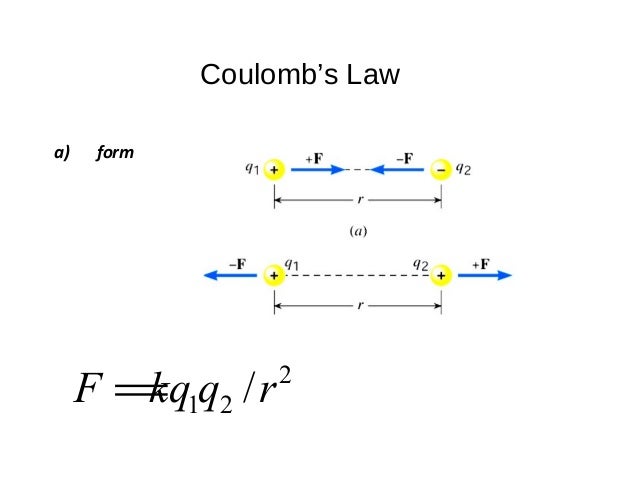
The formula f=kq1q2/r^2 gives the force between two point charges of q1 and q2 coulombs that are r metres apart. The eq of electrostatic force is f=kq1q2/r2, so in lhc should it be impossible to collide 2 protons together in synchrotron as r=0 and f=infinity? As vacuum has no medium so no dielectric is formed in surroundings by charge so no decrease in electric field.
F = Kq1Q2 / R2, Where K Is A Constant.
If we now introduce a proportionality constant k , then: E = f/q, where f is the force on the charge q, with e and f being vectors such that the direction of e is the same direction as the force on a positive test charge. As vacuum has no medium so no dielectric is formed in surroundings by charge so no decrease in electric field.
This Still Does Not Explain To Me What Is The Actual Logic Behind The Formula.
Charge of object 2 r. Coulomb s law fe k q1 q2 r 2 radius squared charge 1 charge 1 electron proton electric force. Use the formula f = kqq/r2 to determine the force when the distance (r) between charge q1 and q2 increased from 3m to 4.5m.
Check How Easy It Is, And Learn It For The Future.
K ( 1/4π€°) is permittivity of space i.e how much net electric field space permits to cause force. The eq of electrostatic force is f=kq1q2/r2, so in lhc should it be impossible to collide 2 protons together in synchrotron as r=0 and f=infinity? Charge of object 1 q2:
Our Solution Is Simple, And Easy To Understand, So Don`t Hesitate To Use It As A Solution Of Your Homework.
What is k in kq1q2 r 2? Julio ontiveros rodríguez la expresión matemática de la ley de coulomb es: Consider the equation for coulomb's law, f = kq1q2 r2 , where k is a constant.
The Force Between Charges Q1 And Q2 Separated By A Distance R Is Given By Coulomb’s Law:
The formula f=kq1q2/r^2 gives the force between two point charges of q1 and q2 coulombs that are r metres apart. Simple and best practice solution for f q1q2 r2 k equation. Suppose we vary r over some interval, and then measure f at every value of r, keeping q1 = 5 × 10⁻⁶ and q2 = 20 × 10−6 (both in units of coulombs, or c) question:
