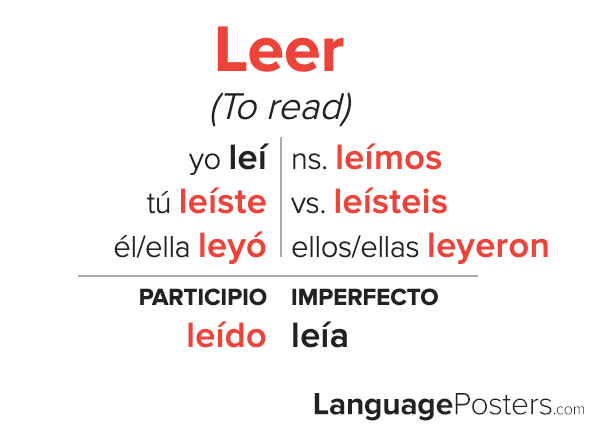
Preterite Tense Leer. Leer appears on the 100 most used spanish verbs poster as the 13rd most used irregular verb. Yo leía, tú leías, él / ud.…
Leer Preterite Tense Conjugation Spanish Preterite Tense from languageposters.com
In other words, one must eventually forget the verb chart and it must become second nature. The preterite tense is a leer past tense conjugation that is equivalent to the english past tense ''i read.'' it has a regular conjugation except for. If it ends in any other consonant, the.
For The Preterite Tense Conjugation, Go To Leer Preterite Tense Conjugation.
If it is pronounced elsewhere, you must put an accent mark on that syllable. Select the correct answer based on the the pronoun preceding it. All but the nosotros form have an accent mark.
Choose From 500 Different Sets Of Tenses Present Preterite Leer Flashcards On Quizlet.
If it ends in any other consonant, the. Definition to read additional information remember: (?) back to main conjugation page want to speak with one of our online spanish tutors?
In Such Cases, The Imperfect Tense Is Used.
Leí, leíste, leyó, leímos, leísteis, leyeron. 1/21717 practice spanish with music to increase focus & retention! Using the chart below you can learn how to conjugate the spanish verb leer in present tense.
The Best Advice I Can Offer You Is To Sound Out Every Verb That You Conjugate.
In other words, one must eventually forget the verb chart and it must become second nature. Lee nosotros leemos vosotros leéis ellos / uds. Present preterite future conditional imperfect present progressive present perfect past perfect future perfect conditional perfect past anterior present subjunctive imperfect subjunctive future subjunctive preterite perfect subjunctive past perfect subjunctive future perfect subjunctive positive imperative negative.
For Example, Leí Un Libro , Meaning I Read A Book .
If you are truly dedicated to learning spanish, you’ll put in the time necessary to memorize the handful of irregular patterns that occur. It is always used when listing a. The indicative preterite of leer is used to talk about actions completed in the past, at a specific point in time.